
Fluvanna County Sex Offender Checks
The Virginia Sex Offender and Crimes Against Minors Registry is the first public channel for a Fluvanna County sex offender lookup. Virginia State Police manages the data under the Registry Act. The portal supports name and place searches, and its public results are limited to details that state law permits VSP to release. It is not a list of every person convicted of a crime, every person once charged, or every current court case.
The Fluvanna County Sheriff's Office is the local law-enforcement contact for registration work and suspected noncompliance. It does not advertise a separate public county registry or a mobile registry app. That makes the live state portal the main place to check public profiles. A searcher should gather a correct name, an alias if known, or a precise location before starting. For a concern about immediate safety, call law enforcement instead of trying to confirm facts through a web search.
Fluvanna Registry and Criminal Records
A Fluvanna County registry result and a criminal-history record answer different questions. The registry reports a current statutory duty and the public facts tied to it. A VSP Central Criminal Records Exchange check joins reportable arrest and disposition data by identity. A Virginia court file follows one prosecution through charges, hearings, disposition, and sentence. None can safely stand in for the others.
This distinction matters when a name appears in one system but not another. The public registry can omit information that is restricted to law enforcement. A court case may be older, sealed, or filed under a different case number. A registry profile may show the conviction jurisdiction without reproducing the whole judgment. Anyone who needs the original outcome should use the relevant court file and the Fluvanna Sheriff's local court directory. The broader Fluvanna County criminal-history overview explains how local court and repository records fit together.
Note: Registry inclusion reflects a legal registration duty; it does not turn the public profile into a complete account of the person's record.
Virginia Sex Offender and Crimes Against Minors Registry Searches
Start at the official VSP registry and read its conditions of use. A county filter focuses the result set on Fluvanna County, while name, city, ZIP, street, and radius tools answer different location questions. Mailing labels do not always match incorporated boundaries, so a geographic result should be read as the portal presents it. Spellings and aliases can also split results. Use more than one route when the first search is too broad or returns no clear match.
- Open the VSP registry search and accept the official conditions.
- Choose a name search or use the Fluvanna County and geographic controls.
- Compare the result list by the public identifiers, not by name alone.
- Open the current profile, read its status and offense fields, and record the date checked.
| Field Label | Type | Required | Notes |
|---|---|---|---|
| Last Name | Text | Optional by route | Spelling and alias limits apply |
| First Name | Text | Optional | Narrows a name search |
| County | Dropdown | Optional | Select Fluvanna for a county-focused list |
| City or ZIP | Text or dropdown | Optional | Mailing locality may differ from a town boundary |
| Street or Address | Text | Address route | Supports proximity mapping |
| Radius | Dropdown | Radius route | Read the current options in the live portal |
| Map or List | View control | No | Changes the geographic presentation |
Fluvanna Registry Versus NSOPW
The VSP registry is the primary Virginia source. The National Sex Offender Public Website, run by the U.S. Department of Justice, adds a cross-state search layer. It is useful when a person may have moved or when the relevant place sits beyond Virginia. NSOPW brings participating jurisdictions into one query, but the originating jurisdiction still controls the underlying public data and update cycle.
The Justice Department's national search interface shows why the cross-state layer helps a Fluvanna County registry check.
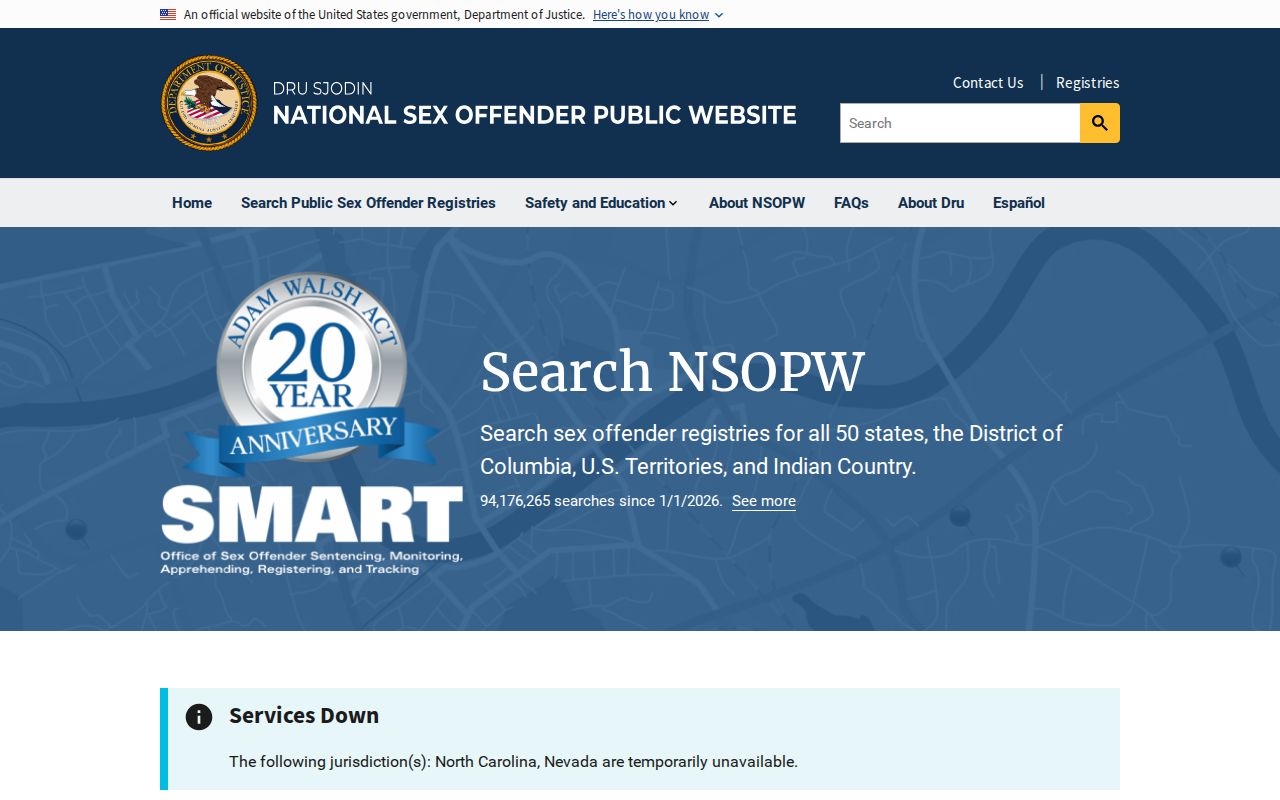
Use the national result to locate the source profile, then verify the latest Virginia facts in the VSP registry. Do not treat a national no-result as proof that no public registration record exists. Search terms, aliases, jurisdiction participation, and data timing can affect what appears.
Registry Profiles: What They Show
A public Fluvanna County registry profile may combine identity, appearance, address, offense, and registration facts. The exact fields depend on what Virginia law authorizes for that record. Some protected addresses and law-enforcement-only data will not appear. Older pre-1994 supplement entries under Virginia Code § 9.1-923 carry a narrower public field set, such as a name, birth year, conviction place and date, age at conviction, offense, and Code section.
| Name & Aliases | Public identity names and known aliases authorized for display |
|---|---|
| Photo & Physical Description | Photograph and authorized traits such as sex, race, height, weight, hair, eyes, scars, marks, or tattoos |
| Registered Address | The public registered location, subject to statutory protection for some address situations |
| Offense & Statute | Conviction offense, Virginia Code section, jurisdiction, date, and authorized victim-age category |
| Vehicles | Vehicle and other statutory information when public |
| Registration Status | Registration, compliance, or status facts that VSP authorizes for public view |
Date Every Fluvanna Registry Check
Registry facts can change. People move, a status can be updated, and VSP may correct information. Write down the date and search route used for a Fluvanna County sex offender lookup. If an address result affects a personal safety plan, return to the current profile rather than relying on a screenshot, old note, or copied list. The live source is the best point of reference.
Location terms need care in this rural county. A city or ZIP field may describe a mailing locality rather than an incorporated boundary. That is especially important near Scottsville, which crosses the Fluvanna and Albemarle county line. The county filter, street search, and map view can each supply part of the answer. Compare them before drawing a location conclusion.
Note: A current address result supports awareness, but it does not authorize a visit, confrontation, surveillance, or contact with a registrant or household.
Registration Levels and Duties in Virginia
Virginia classifies registration duties as Tier I, Tier II, and Tier III based on the governing offense and facts. Virginia Code §§ 9.1-908 and 9.1-909 control duration and verification. Multiple convictions, court relief, and the statutory classification can change the result. Federal SORNA terms and Virginia public-disclosure categories should not be swapped as though they always mean the same thing.
| Tier | General Duration | Verification Research Rule |
|---|---|---|
| Tier I | Generally 15 years | Annual; eligible petitioners may seek relief after the required period |
| Tier II | Generally 25 years | Semiannual under the statutory schedule |
| Tier III | Generally lifetime | More frequent, commonly every 90 days |
These general rules do not calculate one person's duty. Read the current statute and any court order before stating a duration. The registry profile is the public status source, while the sheriff and VSP handle the registration process.
Fluvanna Registration Reaches VSP
Local registration contact runs through the Fluvanna County Sheriff's Office at 160 Commons Boulevard in Palmyra, telephone (434) 589-8211. A registrant must follow VSP and local instructions for initial registration, later verification, and changes. Under 19VAC30-170-15, forms, a photograph, fingerprints, and palm prints are sent to the VSP CCRE Registry. The public should not try to manage or enforce that process.
If a profile appears wrong, save the official URL and search date, then contact the agency that maintains the field. A public-record request to the Sheriff's VFOIA channel can seek an existing local record, but disclosure rules and public-profile rules are not identical. Some criminal and investigative information may be withheld or redacted. The registry portal remains the correct public source for the profile VSP is authorized to disseminate.
Federal Cases and Fluvanna Registry Profiles
Federal court records are another separate layer. The PACER federal case search can locate a federal docket, but it does not replace a Fluvanna County registry search or show a person's current Virginia registration status.
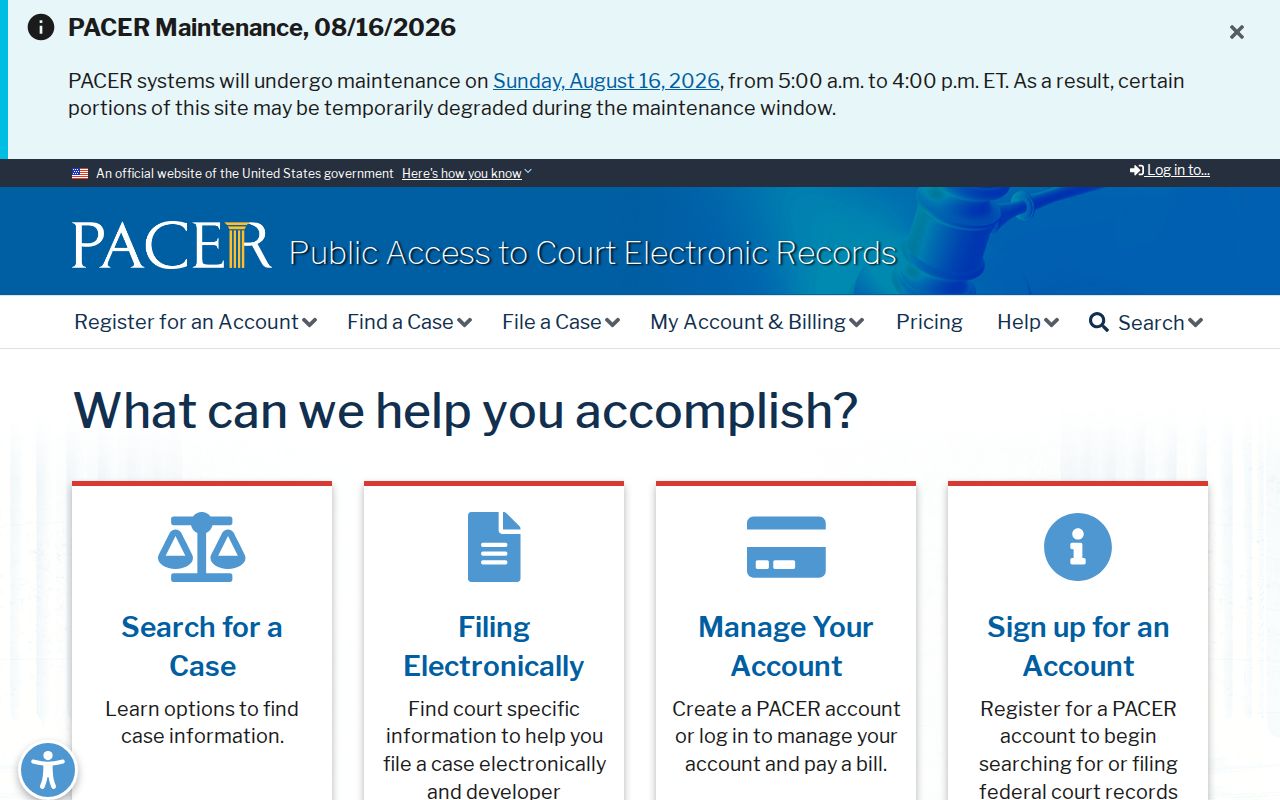
The PACER interface illustrates the difference between a case-search tool and a registry tool. A federal docket follows pleadings and court events. The VSP profile follows the public registration fields set by Virginia law. When both sources matter, cite each for the narrow fact it actually holds.
Using Registry Information Lawfully
Registry access supports personal, family, and community safety. Suspected noncompliance should go to the Fluvanna County Sheriff's Office or Virginia State Police. Give the official profile link, the fact that raised concern, and the date observed. Do not investigate in person. For an urgent threat, use the proper emergency channel.
Virginia Code § 9.1-914 governs public dissemination and restricts misuse. The portal disclaimer also sets conditions for use. A profile may be incomplete, recently changed, or tied to an address that needs current confirmation. Safety planning should stay factual and lawful.
Registry misuse is a crime: Virginia prohibits using registry information to intimidate or harass. Do not threaten, trespass, discriminate outside the law, or engage in vigilantism.